
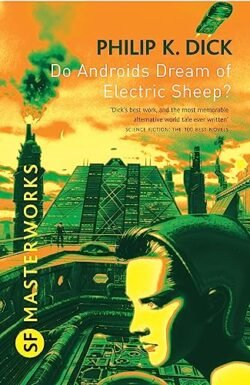
“Do Androids Dream of Electric Sheep?” by Philip K. Dick is a landmark science fiction novel set in a post-apocalyptic future where Earth is devastated by nuclear war, leading to widespread desolation and the extinction of many animal species. The story follows Rick Deckard, a bounty hunter employed to identify and “retire” rogue androids that have fled to Earth. These androids, indistinguishable from humans except for their lack of empathetic capacity, challenge the very notion of what it means to be human. As Deckard tracks down these androids, he is forced to confront his own morality, empathy, and the value of artificial life.
Character Analysis
- Rick Deckard: Rick Deckard, the novel's protagonist, embodies the moral and existential quandaries central to the story. As a bounty hunter of androids, his job requires him to suppress his empathy—a trait that distinguishes humans from androids in the novel's universe. Deckard's encounters with advanced Nexus-6 model androids, who exhibit sophisticated emotional responses, force him to question the ethics of his work and the nature of his own humanity.
- Androids (Andys): The androids, or "andys," primarily the Nexus-6 models, challenge preconceived notions of artificial intelligence and soullessness. Characters like Rachael Rosen and Pris Stratton are particularly instrumental in blurring the lines between human and machine. Their complex behaviors, emotions, and desires for self-preservation prompt readers to reconsider the boundaries of empathy and the rights of sentient beings, regardless of their origin.
Themes and Analysis
- Empathy as a Measure of Humanity: The novel posits empathy as the defining trait of humanity, explored through the empathy test used to identify androids and the characters' interactions.
- The Value of Life: Whether through Deckard's moral conflict or the androids' fight for survival, the narrative probes the value of life in a world where the line between organic and artificial life is blurred.
- "Do Androids Dream of Electric Sheep?" offers a profound exploration of identity, empathy, and ethics within the framework of a dystopian future. Philip K. Dick masterfully crafts a narrative that is as engaging as it is thought-provoking, pushing readers to question the essence of humanity in the face of advanced artificial intelligence. The novel's enduring relevance speaks to ongoing debates about AI, making it a seminal work in science fiction and beyond. Rick Deckard's journey through a decaying world where androids dream of life serves as a compelling meditation on what it means to be truly human.
“Do Androids Dream of Electric Sheep?” offers a profound exploration of identity, empathy, and ethics within the framework of a dystopian future. Philip K. Dick masterfully crafts a narrative that is as engaging as it is thought-provoking, pushing readers to question the essence of humanity in the face of advanced artificial intelligence. The novel’s enduring relevance speaks to ongoing debates about AI, making it a seminal work in science fiction and beyond. Rick Deckard’s journey through a decaying world where androids dream of life serves as a compelling meditation on what it means to be truly human.
If the summary caught your interest,
Consider reading the full book on AbeBooks.
Explore this book on AbeBooks